Content feed Comments Feed
https://blogger.googleusercontent.com/img/b/R29vZ2xl/AVvXsEjwyMFzFySiQpaUXy-bPhyphenhyphenpyvAkgRSAKv-_DYmCic9xNUi_Z4KXJlXdnTWuyJqq577-gjGTpHaBy2NBDuAj0mC6dzJM9ljdaML0DKnX-abhRdAX4gi76v6nMOj5XgKZeLces-xK_vKfrsPG/s1600/2013-Renault-Clio-Cup-0.jpg
2014 Renault Clio Cup【Video】Renault has released the first details for the 2014 Clio Cup. The 2014 Renault Clio Cup will be exclusively offered will go on sale in September of 2013 with pricing starts at €37,800.
Showing posts with label F1. Show all posts


The McLaren F1 turns 25 years old as it was launched back in 1988. 25 years later, the McLaren F1 is still the fastest normally aspirated production road car in the world and one of the most expensive cars ever built.

Over the course of four years, McLaren produced 64 F1, five F1 LM and three F1 GT road cars, along with 28 F1 GTR racers and six test prototypes. At the end of its lifespan in 1998, the F1 became the world's fastest production car, and while that title is now reserved for the almighty Bugatti Veyron, the McLaren still holds the record for fastest naturally aspirated road car. (Tricky, tricky!) Beyond that, the F1 garnered a healthy amount of respect for dominating Le Mans – these cars took first, third, fourth, fifth and thirteenth place at the 1995 24 Hours of Le Mans, as well as winning that year's GT1 championship.


Taking cues from its F1 endeavors, the McLaren F1 road car utilizes a carbon-fiber shell that weighs just 220 pounds yet offers impressive rigidity. A BMW-sourced 6.1-liter V-12 puts out 627 horsepower and 586 pound-feet of torque, lofty numbers even by 2010 standards, while a 2500-pound curb weight, ABS-less brakes, and a finely honed double-wishbone suspension kept drivers tuned to the road. Famously, the F1 had a central seating position, which led to the addition of two passenger seats for a three-seat configuration.

The McLaren F1 is powered by a 6064 cc BMW V12 engine developing between 600 and 680 hp. The most powerful version was the McLaren F1 LM Roadcar which had an output of 680 hp and was built in only 5 units during 1996.

The price of a McLaren F1 at the launch was a staggering 540,000 GBP. At that time it was the most expensive car in the world. Another first for the McLaren F1 was that it was the first production road car to feature a full carbon fiber monocoque chassis.


McLaren F1 turns 25 McLaren F1 turns 25 McLaren F1 turns 25 McLaren F1 turns 25 McLaren F1 turns 25 McLaren F1 turns 25 McLaren F1 turns 25 McLaren F1 turns 25 McLaren F1 turns 25


Press Release

McLAREN AUTOMOTIVE CELEBRATES 20TH ANNIVERSARY OF THE LEGENDARY McLAREN F1
  • McLaren F1 is still the fastest normally aspirated production road car in the world.
  • McLaren F1 GTR secured McLaren's position as the only car manufacturer to win the Formula 1 World Championship, Indianapolis 500 and Le Mans 24 Hours
  • McLaren F1 was first production road car to use a full carbon fibre monocoque
  • 20 years of carbon pioneering behind McLaren's launch of the new MP4-12C in 2011
In 1988, McLaren took the decision to expand from Formula One and design and build "the finest sports car the world had ever seen". In March 1990 the team that was to create the F1 came together for the first time. In its 20th anniversary year, the McLaren F1 is considered by most people to be one of the greatest cars of all time. Its exclusivity, technical innovation, racing provenance, revolutionary packaging and extraordinary driving experience have made it an icon.

Just two years later, the McLaren F1 road car was launched to the world on 28th May 1992 in Monaco, with the first production car delivered to its proud owner in December 1993.

The F1 defines the McLaren road car DNA

McLaren is a carbon pioneer. The McLaren Formula 1 team was the first team in Formula 1 to use a carbon fibre chassis in 1981. Nine years on, these Formula 1 techniques were developed to create the carbon monocoque for the McLaren F1: the resulting structure weighed just 100kg whilst offering the highest levels of strength and safety. The bare carbon fibre passenger doors weighed just 7 kg each (which included the weight of the side intrusion beam).

The F1 defined the McLaren road car DNA: low weight, low polar moment of inertia, clever packaging, superb quality and innovative design, resulting in an outstanding driving experience.

The F1 bristles with innovative design. The central driving position, which ensures superb visibility and no compromise on control positions for the driver; the pannier side lockers providing unprecedented levels of luggage capacity in a car of this type; the patented suspension system to provide both control and ride quality.

The F1 was launched at a price of £540,000 in 1994, and over the course of the next four years 64 F1, 5 F1 LM and 3 F1 GT road cars were produced, together with 28 F1 GTR race cars. An additional six prototypes were produced.

In October 2008, a delivery mileage F1 was sold at auction for £2.53 million, underlining the F1's status as one of the great motoring icons.

Taking a road car to the track

In 1994, after pressure from owners, McLaren developed a racing version of the F1 road car to run in the FIA GT1 category in the 1995 season. Despite a design and development period of just 3 months, the F1 GTR swept all before it, winning not only the 1995 GT1 Championship, but also the 24 Heures du Mans on its debut. McLaren not only won, but dominated the rain-soaked endurance race, finishing in 1st, 3rd, 4th, 5th and 13th places.

The Le Mans winning F1 GTR was piloted by J.J. Lehto, Yannick Dalmas and Masanori Sekiya. Lehto's performance through the night on a treacherous circuit has been hailed as one of the great racing performances of all time, taking up to 10 seconds a lap off the cars in front of him. The winning car is proudly displayed at the McLaren Technology Centre in exactly the condition that it finished Le Mans in 1995.

Thus the F1 GTR secured for McLaren a unique position in motor racing history, as the only manufacturer to win the Formula 1 World Championship, the Indianapolis 500 and the Le Mans 24 Hours.

McLaren decided to celebrate the extraordinary result at Le Mans by creating 5 F1 LM road cars, one for each F1 that finished this most grueling of races. Launched in McLaren Orange, as used on Bruce McLaren's race cars the 1960s and 70s, and with a derestricted race engine, the LM is not only the most powerful of all F1 variants, but also the most valuable. Formula 1 fans will recognize this as the car which Lewis Hamilton has set his heart on owning.

In 1997, the final iteration of the F1 road car project was built. The F1 GT was built solely to fulfil the new homologation rules for the 1997 GTR race car, of which 10 examples were produced in the same year. Both the GT road car and the 1997 GTR race cars became known as the 'Longtail', because of the longer front and rear overhangs for improved downforce when racing. Although McLaren only had to build one car for homologation purposes, two more were built following requests from existing F1 owners.

In 1998, with a total of 106 of all variants built and its production run complete, the McLaren F1 went on to achieve its greatest feat outside competitive motorsport. McLaren development and race driver Andy Wallace took XP5, the fifth and final prototype F1 with some 45,000 hard test miles on the clock, to the Ehra-Lessien proving ground in Germany. It was here on 31st March 1998 that the howling V12 propelled him to an amazing 240.1mph. Over 12 years later, this remains a world record for a naturally aspirated production car.

Back to the F1 future

On 27th April 2010, McLaren Automotive celebrated the 20th Anniversary of the start of the F1 programme by inviting F1 owners past and present to a celebration dinner at the McLaren Technology Centre in Woking, England. The following day, after an insight into McLaren Automotive's exciting plans for a future range of high performance sports cars, the owners were treated to a display of 21 McLaren F1 road and race cars, the largest number of F1 cars ever assembled in one place.

Ron Dennis, McLaren Automotive Executive Chairman, said:
"The F1 is a technological tour-de-force and a real triumph in terms of packaging and design. Whether endurance racing or on road, it is supremely fast, agile and yet comfortable. Its styling is enduring and will never fade. I enjoy driving mine more today than ever before because I find its technical purity highly satisfying; the F1 remains one of McLaren's proudest achievements."
With the launch of McLaren Automotive as a new car company announced in March 2010, the company begins production planning for an entire range of high performance sports, designed and built in-house by McLaren. The first in this range will be the MP4-12C.

The 12C shares much of the design philosophy that was applied to the McLaren F1. Starting with the new car's MonoCell, a one-piece carbon fibre chassis that is stiff, light and ensures occupant safety, every component has been designed to ensure the car is lightweight, nimble and able to deliver ultimate performance. When the 12C launches in 2011, it will be the first in the 'core' sports car sector to offer a carbon chassis, and the first road car ever with a one-piece, moulded carbon chassis.

From the outset, the 12C has been 'designed around the driver'. Outstanding aerodynamic efficiency and bespoke technologies including Proactive Chassis Control, Seamless Shift dual-clutch Gearbox (SSG), Brake Steer and the 12C's unique Airbrake feature in a car which has been developed using Formula 1 simulator technology. The new high performance sports car from McLaren will be sold initially through 35 retailers in 19 different countries around the world from Spring 2011.

McLaren's celebration of the 20th anniversary of the F1 will continue throughout the year.

McLaren enthusiasts will have the opportunity to see both the F1 and 12C together at this summer's Goodwood Festival of Speed, which takes place at the famous English motorsport venue from 2-4 July 2010.

Technical specifications of each McLaren F1 derivative are detailed below.

ModelF1 RoadcarF1 GTR RacecarF1 LM Roadcar
Year of production1993-9819951996
Examples built6495
EngineBMW V12BMW V12BMW V12
Cubic Capacity6064 cc6064cc6064cc
Engine ManagementTAG 3.12 Ignition/InjectionTAG 3.12 Ignition/InjectionTAG 3.12 Ignition/Injection
Power output (bhp)627600680
TransmissionTransverse 6-speed Limited Slip DifferentialAluminium case transverse 6-speed, LSDTransverse 6-speed Racing Unit, LSD
ChassisCarbon fibre reinforced composite monocoqueCarbon fibre reinforced composite monocoqueCarbon fibre reinforced composite monocoque
BodyCarbon fibre composite panelsCarbon fibre composite panelsCarbon fibre composite panels
Front SuspensionDouble wishbones, Ground Plane Sheer centre sub-frame light alloy damper/co-axial coil spring, anti-roll barDouble wishbones, light alloy damper/co-axial coil spring, anti-roll barDouble wishbones, light alloy damper/co-axial coil spring, anti-roll bar
Rear suspensionDouble wishbones, Inclined Axis Sheer mounting, light alloy damper/coaxle coil spring, toe-in/toe-out control linksDouble wishbones, light alloy damper/coaxle coil springDouble wishbones, light alloy damper/coaxle coil spring
Brakes F/ROutboard 13/12in ventilated discsOutboard 15/14in ventilated carbon discsOutboard 13/12in ventilated discs
Wheels: Diameter x Width F/R17x9/17x11.5in18x10.85/18x13in18x10.85/18x13in
Tyres F/RGoodyear F1, Michelin SX-MXX3MichelinMichelin SX-MXX3
Length169in/4292mm169in/4292mm171.8in/4365mm
Width71.6in/1820mm71.6in/1820mm71.6in/1820mm
Height44.8in/1140mm44.8in/1140mm44.1in/1120mm
Wheelbase107in/2718mm107in/2718mm107in/2718mm
Track F/R61.7/58in / 1568/1472mm61.3/58.6in /
1558/1488mm
61.8/57.6in /
1570/1464mm
Weight2502lb/1140kg2315lb/1050kg2341lb/1062kg

ModelF1 GTR RacecarF1 GT RoadcarF1 GTR Racecar
Year of production199619971997
Examples built9310
EngineBMW V12BMW V12BMW V12
Cubic Capacity6064 cc6064cc5990cc
Engine ManagementTAG 3.12 Ignition/InjectionTAG 3.12 Ignition/InjectionTAG 3.12 Ignition/Injection
Power output (bhp)600627600
TransmissionMagnesium case transverse 6-speed Limited Slip DifferentialTransverse 6-speed, Limited Slip DifferentialMagnesium case transverse 6-speed
ChassisCarbon fibre reinforced composite monocoqueCarbon fibre reinforced composite monocoqueCarbon fibre reinforced composite monocoque
BodyCarbon fibre composite panelsCarbon fibre composite panelsCarbon fibre composite panels
Front SuspensionDouble wishbones, light alloy damper/coaxle coil spring, anti-roll barDouble wishbones, Ground Plane Sheer centre sub-frame light alloy damper/co-axial coil spring, anti-roll barDouble wishbones, light alloy damper/co-axial coil spring, anti-roll bar
Rear suspensionDouble wishbones, light alloy damper/co-axial coil springDouble wishbones, Inclined Axis Sheer mounting, light alloy damper/co-axial coil spring, toe-in/toe-out control linksDouble wishbones, light alloy damper/co-axial coil spring
Brakes F/ROutboard 15/14in ventilated carbon discsOutboard 13/12in ventilated discsOutboard 15/14in ventilated carbon discs
Wheels: Diameter x Width F/R18x10.85/18x13in18x10.85/18x13in18x10.85/18x13in
Tyres F/RMichelinMichelinMichelin
Length172in/4367mm194in/4928mm194.2in/4933mm
Width74.8in/1900mm76.4in/1940mm75.6in/1920mm
Height42.9in/1090mm47.2in/1200mm47.2in/1200mm
Wheelbase107in/2718mm107in/2718mm107.2in/2723mm
Track F/R61.3/58.6in / 1558/1488mm63.3/62.3in /
1620/1582mm
63.7/62.3in /
1617/1582mm
Weight2231lb/1012kg2469lb/1120kg2017lb/915kg


Red Bull Racing underlined its practice form by locking out the front row of the grid for the Spanish Grand Prix with Mark Webber (1:19.995) going quickest in each session and winning his personal battle with team mate Sebastian Vettel (1:20.101).

The harsh reality for the chasing pack is that they appear to be nowhere remotely close to Adrian Newey's impressive RB6. So marked was the Red Bull superiority that the cars were quickest after the first Q2 runs despite running the harder Bridgestone tyre while everyone else was on the softer option rubber. It was only for the last run, in preparation for their own personal Q3 battle, that the Red Bull men went out on the softs.

more detail. ...


PositionDriverTeamQ1Q2Q3laps
1Mark WebberRedbull1:21:4121:20:6551:19:99518
2Sebastian VettelRedbull1:21:6801:20:7721:20:10120
3Lewis HamiltonMcLaren1:21:7231:21:4151:20:82917
4F AlonsoFerrari1:21:9571:21:5491:20:93723
5Jenson ButtonMcLaren1:21:9151:21:1681:20:99118
6M SchumacherMercedes1:22:5281:21:5571:21:29418
7Robert KubicaRenault1:22:4881:21:5991:21:35316
8Nico RosbergMercedes1:22:4191:21:8671:21:40822
9Felipe MassaFerrari1:22:5641:21:8411:21:58524
10KobayashiBMW1:22:5771:21:7251:21:98420
11Adrian SutilForce India1:22:6281:21:985 17
12Pedro de la RosaBMW1:22:2111:22:026 17
13Nico HulkenbergWilliams1:22:8571:22:031 14
14Vitaly PetrovRenault1:22:9761:22:139 14
15S BueimiToro Rosso1:22:6991:22:191 16
16Jaime AlguersuariToro Rosso1:22:5931:22:207 15
17T LuizziForce India1:22:0841:22:854 18
18R BarrichelloWilliams1:23.125  9
19Jarno TrulliVirgin1:24.674  10
20Heikki KovalainenLotus1:24.748  10
21Timo GlockLotus1:25.475  8
22Lucas di GrassiVirgin1:25.556  7
23Karun ChandhokHRT1:26.750  8
24 HRT1:27.122

[724607399.jpg]

As the start of the Formula 1 season got underway last weekend, an issue concerning F1 coverage on WCF came up regarding the way we title articles containing race results.

Some readers protested that we were giving away the race results in the titles before they were ready to find out (e.g. "Alonso wins first race of 2010 season"). Due to time zone differences and the availability of television broadcasts around the world, some readers who had not seen the race yet, were informed of the race results against their will after seeing the article title published on the WCF main page or RSS feed.

more detail. ...

2010 Renault R30 with LADA logo branding

The Renault F1 Team today confirmed a cooperation agreement that will see branding from Lada, Russia's leading automotive marque, feature on the chassis of the Renault F1 Team R30 race cars during the 2010 season.

Lada branding will also appear on the overalls and team uniform of 25-year-old Vitaly Petrov, who will make history this year as the first ever Russian F1 driver.

This landmark agreement was formally signed in Moscow last Monday, March 1. Russian Prime Minister Vladimir Putin also gave the agreement his public endorsement.

2010 Renault R30 with LADA logo branding

"We are proud to announce this new agreement, which marks another important step for the Renault F1 Team and Formula 1 in Russia," commented Renault F1 Team Chairman Gerard Lopez.

"Through Mangrove Capital we have been actively investing in Russia over the last years. We know the country well, we have a high degree of appreciation for it and, as such, it is an honour for our F1 team to spearhead Russia's entry into the sport and to carry the Lada brand at the highest level of world motorsport. We look forward to an exciting and successful season together."

Source:GMM;Photos f1fanatic


When the new Formula-1 season gets underway in Manama/Bahrain (12-14 March 2010), it will mark the debut of the most spectacular and powerful Official F1TM Safety Car of all time. The job of the new Mercedes-Benz SLS AMG, which will be launched on 27 March 2010, is to ensure maximum safety in Formula 1. The "gullwing" model replaces the SL 63 AMG, which was used as the Official F1TM Safety Car in 2008 and 2009. As in the last two years, the C 63 AMG Estate will be used as the Official F1TM Medical Car for the coming season.

"Together with the entire AMG Team, I am very proud that the new SLS AMG is the official F1 safety car. I'm sure all Mercedes and AMG fans will be excited to see the gullwing model together with the new Mercedes GP Petronas Team at the F1 circuits," says Volker Mornhinweg, Chief Executive Officer of Mercedes-AMG GmbH.

From March 2010, the Official F1TM Safety Car will be deployed whenever hazardous situations such as accidents or bad weather endanger normal racing. The SLS AMG, piloted by Bernd Mayländer (38, from Germany), will be on standby in the pit lane throughout the entire race. When radioed by Race Control, the former DTM driver and his co-driver, FIA man Pete Tibbetts (44, from the UK) will take to the track at the head of the field in order to guide the Formula-1 race cars safely around the circuit.


Unique vehicle concept for maximum driving dynamics

The Mercedes-Benz SLS AMG has the best possible credentials for this demanding role in the top flight of motor racing: its 6.3-litre V8 engine has a peak output of 420 kW (571 hp) and a maximum torque of 650 Nm, enabling the gullwing model to sprint from 0 to 100 km/h in 3.8 seconds. Fast lap times are a must for the Official F1TM Safety Car, otherwise the Formula-1 cars' tyres and brakes would cool down too quickly, while their engines could overheat.


The unique vehicle concept is a key factor in ensuring outstanding driving

dynamics: the aluminium spaceframe body keeps the vehicle weight down to 1620 kilograms (DIN kerb weight). And thanks to the dry-sump lubrication system, the AMG V8 powerplant can be installed very low down, resulting in a beneficial lowering of the vehicle's centre of gravity. The installation position a long way behind the front axle and the transaxle arrangement of the new seven-speed double-clutch transmission on the rear axle have a positive effect on the weight distribution, which is 47/53 percent (front/rear). Pure motorsport tech-nology is used for the AMG sports suspension: aluminium double-wishbone axles front and rear ensure outstanding driving dynamics with precise turn-in ability, first-class agility, low mass inertia when changing direction spontaneously and, therefore, a high cornering limit.


Double-clutch transmission and ceramic composite brake system

The AMG SPEEDSHIFT DCT 7-speed sports transmission with double-clutch technology features four modes and allows fast gear changes with practically no interruption in tractive power - in manual mode ("M"), gear changes can be effected in 100 milliseconds. Together with the 3-stage ESP®, the integrated mechanical multidisc differential lock ensures outstanding traction. Meanwhile, braking distances are minimised and resistance to fading is maximised, even when the brakes are subject to typical race-track loads, courtesy of the AMG ceramic high-performance composite brake system with its generously sized ceramic discs measuring 402 x 39 mm on the front axle and 360 x 32 mm on the rear axle. The weight-optimised 10-spoke forged wheels are shod with 265/35 R 19 (front) and 295/30 R 20 (rear) tyres.

The Official F1TM Safety Car features the same engine, power transmission, suspension and brake system as the standard-production SLS AMG. The exceptional technology package for the super sports car ensures perfect driving dynamics and means that no further technical modifications or lightweight-design measures are necessary, with the sole exception of the all-new rear silencer, which allows the high-revving AMG V8 naturally aspirated engine to breathe more easily and offers Formula-1 fans an even more emotionally charged sound experience.


Aerodynamically optimised roof light bar incorporating LED technology

Compared to the standard-production SLS, the Official F1TM Safety Car is distinguishable on the outside by its prominent F1 logos, carbon-fibre exterior mirrors and the characteristic roof light bar with integrated TV camera. It sits on an all-new carbon-fibre hood whose shape has been tested in the wind tunnel to ensure optimum airflow at the rear aerofoil. The aerofoil pops up when the car reaches 120 km/h and, together with the rear diffuser, provides the necessary rear downforce. LEDs are used for all light functions for the first time in the new, aerodynamically styled roof light bar. Their advantages over the previously used bulbs lie in their extremely fast response time and low power consumption.

The two centrally positioned green lights in the aerodynamically optimised light bar are illuminated when the Official F1TM Safety Car joins the field and first needs to overtake all the racing cars in front of it. Once the SLS AMG has assumed the leading position, the outer orange flashing lights are switched on to signal to the Formula-1 drivers that no overtaking whatsoever is allowed. The white stroboscopic lights in the headlamps and tail lights perform a general signalling function in that they always flash whilst the safety car is deployed. A special number plate at the rear, with "Safety Car" lettering and 700 LEDs, provides additional safety in darkness or wet weather. A reversing camera is integrated to the left of the number plate, allowing those in the cockpit of the Official F1TM Safety Car to keep an eye on the Formula-1 cars behind via monitor.


Practical interior with AMG sports bucket seats

The distinctive gullwing doors open to reveal a practical cockpit which, like the exterior, differs only slightly from that of the standard-production model. AMG sports bucket seats with black leather upholstery and six-point seat belts ensure optimum lateral support. On the right side of the AMG DRIVE UNIT, there are four coloured buttons for controlling the various light functions, along with the signal horn, which is activated when the car is driving into and out of the pit lane. The centre console, like various other interior trim parts, is finished in genuine carbon fibre, while the AMG performance steering wheel in leather/Alcantara features a specially shaped grip area, a high-quality genuine-metal insert and a flat-bottomed rim with a diameter of 370 millimetres. Two genuine-metal shift paddles are used to change between the seven gears in the double-clutch transmission.

Two central monitors in the SLS AMG cockpit are used to monitor the progress of the race. To the left and right of the lower monitor are the controls for the radio system, which allows Bernd Mayländer and Pete Tibbetts to communicate with Race Control as well as with each other. A second interior mirror lets the co-driver keep an eye on the Formula-1 cars behind. Meanwhile, the "Marshalling System" is integrated in the central display on the instrument cluster and in the lid of the glove compartment: here the driver and co-driver can see exactly the same signals as the Formula-1 drivers in their cockpits. For instance, the various LEDs indicate when yellow or green flags are being waved. LEDs indicating the status of the roof light bar, along with an on-board camera angled towards Bernd Mayländer, are mounted at the front end of the dashboard.


C 63 AMG Estate once again Official F1TM Medical Car

The SLS AMG is not the only AMG high-performance car to be involved in the Formula-1 World Championship: as in 2008 and 2009, the C 63 AMG Estate is the Official F1TM Medical Car - responsible for ensuring rapid emergency response in the event of an accident. The lightning-fast estate car follows the Formula-1 field on the start lap because the race cars are still bunched extremely closely together during this critical phase of the race.

The concept on which the AMG Estate is based is ideal for meeting the requirements of Formula-1: outstanding driving dynamics are assured courtesy of the AMG 6.3-litre V8 engine developing 336 kW (457 hp) with a peak torque of 600 Nm, not to mention the AMG SPEEDSHIFT PLUS 7G-TRONIC transmission, the adjustable coil-over suspension, the AMG light-alloy wheels shod with 235/35 R 19 (front) and 255/30 R 19 (rear) tyres, the differential lock, the 3-stage ESP®, and the AMG high-performance brake system with internally ventilated and perforated composite brake discs on the front axle.

The new AMG front apron with larger air dams is an indicator of the optimised cooling for the water, engine oil, transmission fluid and power steering. One aspect that cannot be seen but can certainly be heard is the distinctive AMG V8 sound emitted from the new rear silencers of the AMG sports exhaust system. Like the Official F1TM Safety Car, the Official F1TM Medical Car is distinguishable by its F1? logos, the roof light bar, and the stroboscopic flashing LED lights at the front and rear. A number plate illuminated with LEDs and displaying the words "Medical Car" on the tailgate makes the car easier to see in darkness or adverse weather conditions.


Plenty of space in the boot for emergency equipment

The Official F1TM Medical Car is piloted by racing driver Alan van de Merwe (from South Africa); his co-driver is the official FIA Grand Prix Chief Medical Officer Dr Gary Hartstein (from Belgium). Two assisting medical experts from a specially selected clinic near the race track sit in the rear. There is plenty of space for all of the emergency equipment - including a defibrillator and respiration apparatus - in the 485-litre boot of the C 63 AMG Estate. Four AMG sports bucket seats with six-point seat belts, two monitors integrated in the centre console for monitoring the race and a radio set for communicating with Race Control distinguish the interior of the Official F1TM Medical Car from that of the standard-production C 63 AMG Estate.

AMG PERFORMANCE STUDIO responsible for development

The development, track-testing and configuration of the two Official F1TM Safety Cars and the two Official F1TM Medical Cars - in both cases, there is one emergency vehicle and one replacement vehicle - are carried out by the specialists from the AMG PERFORMANCE STUDIO in close collaboration with the test team for AMG overall vehicle development. This involves drawing on over 40 years of know-how from the field of motorsport as well as the wealth of experience in the design of high-performance sports cars. Numerous test drives were carried out on various racetracks in order to tune the suspension and verify all the systems and components. Two highly-qualified AMG technicians are also on hand to take responsibility for the deployment of the Safety Car and Medical Car at all 19 Formula-1 races.


Nine generations of Safety Cars from AMG

For 14 years AMG has continuously provided the Official F1TM Safety Car and the Official F1TM Medical Car in the top flight of international motorsport.

More Photos

BERU f1systems Factor 001 cycle - 940

The ultimate riding experience is just around the corner for a few hundred privileged customers as the world's first bike designed and hand built by Formula One engineers receives its finishing touches
A revolutionary new bicycle designed by Formula One engineers at BERU f1systems to deliver the ultimate riding experience is now ready to roll. With smooth, clean lines and a dramatic stance, Factor 001 has been designed to offer a highly responsive ride free from the need to comply with race regulations, and optimised to offer maximum acceleration and stability. Lightweight and robust with a carbon monocoque frame, it will deliver an elite training system for just a few hundred discerning customers worldwide, with the option for riders to record up to 100 channels of biometric, environmental and physical force data.

BERU f1systems Factor 001 cycle - 940

The launch follows a year of track and laboratory tests with feedback from leading sports technologists, during which BERU f1systems perfected its ‘ultimate riding machine' and built the first full production specification model. Each bike will be individually tailored to the customer's exact measurements and design preferences, with the owner's name engraved on the handlebars.
"Every carbon composite component of the bike is crafted in-house drawing upon the same techniques used to produce Formula One components," explains John Bailey, managing director, BERU f1systems. "Each model takes six highly skilled engineers a week to make. With only a limited number of bikes due to be built, we expect Factor 001 to become a desirable collector's item."
Heralded by 220 Triathlon magazine as a ‘rule-destroying speed machine' and ‘mobile sports laboratory', Factor 001, which is currently being displayed in the London Science Museum and is on sale at Harrod's department store, was recognised by France's leading cycling magazine, L'Acheteur Cycliste, as offering supreme rigidity and precision in its steering, with a very lightweight feel and highly reactive acceleration and braking. The magazine's chief bike critic also recognised the mastery of carbon fibre that had gone into its design and manufacture.

BERU f1systems Factor 001 cycle - 1600

"In designing and perfecting Factor 001 we chose not to be limited by any preconceptions surrounding traditional road bike design," comments Bailey. "By starting afresh and working outside the design regulations set out by the Union Cycliste International, we could ensure that nothing would stand in the way of developing an outstanding riding experience. Riders will quickly notice how light the bike feels to ride, and should experience rapid acceleration with minimal exertion."
Factor 001 has a lightweight and highly rigid carbon fibre monocoque structure. Its unique twin-vein architecture can be adjusted to within a millimetre to suit the rider's measurements and typical riding position. In keeping with the frame's robust design, the bike's eight-spoke carbon composite wheels are capable of reliably negotiating tough road conditions. The bike also features the world class Shimano Di2 electronic gear shift, and customers can opt for carbon ceramic disc brakes.
"Our twin-vein design provides substantially improved lateral stiffness and therefore more of the power generated by the rider is transmitted into forward motion," explains Bailey. "A conventional frame, even one made of carbon composite, flexes when the rider applies force to the pedals, which absorbs energy and reduces acceleration. Our twin-vein frame almost completely eliminates this problem, delivering an exceptionally responsive ride."

BERU f1systems Factor 001 cycle - 1600

Packed with BERU f1systems' patented technology, the bike's frame contains highly sophisticated load sensors, wiring, batteries, control cables and lines for its hydraulic braking system, all of which are fully integrated into the composite during construction to give unparalleled efficiency with a clean, uncluttered appearance.
Physical structure aside, the multi-channel electronics package available with the bike has unique ergonometric data collection, logging and analysis capabilities. It can simultaneously correlate biometric data from the ride, physical force data from the bike and environmental data to offer a level of analysis previously only available under laboratory conditions. Riders can record everything from skin temperature and respiration rate to atmospheric pressure and humidity and individual leg power output. The individual channels of data can be displayed on the LCD touch screen, all of which are logged and can be downloaded for post-ride analysis. The rider can configure each screen to display his/her preferred parameters, and the system allows the rider to easily switch between screens whilst riding.
"We have worked in collaboration with sports technology experts at Loughborough University to determine the most efficient means of optimising the bike to suit the rider's individual training needs and riding style, and are now confident that the fine tuning we can offer customers will greatly enhance their training experience," comments Bailey. "Additionally, as the bike is totally customisable, we can also tailor its paintwork and graphics to complement the owner's design preferences."

BERU f1systems Factor 001 cycle - 940

Just as a Formula One driver's car set-up is optimised to allow him to perform at his best, so customers purchasing a Factor 001 bike will be invited to an in-depth cycle fitting and analysis session to ensure that the bike is an exact fit for his/her physical fitness and training needs. The comprehensive fitting session with sports innovation consultancy Progressive Sports Technologies lasts two to three hours, during which an SICI qualified (www.serottacyclinginstitute.com) bike fitter completes a detailed scientific appraisal of the rider's cycling physiology, technique and alignment.
Areas of focus will include posture, core condition, muscle recruitment, pedal force and cleat position, as well as any injury or pain concerns, taking into account the rider's sporting history and using high technology video analyses. Customers can also undergo a series of in-depth fitness tests to measure their maximal aerobic power output, V02max, sub-maximal cycling economy and maximal anaerobic capacity.
The standard bike is available at a cost of £22,000, while the model with integrated electronics, due to be released in April 2010, costs £27,000. The frame is available in pearlescent white with composite masked decals and customer specific schemes can be quoted for upon request. For further information, visit www.factor001.com
More Photos

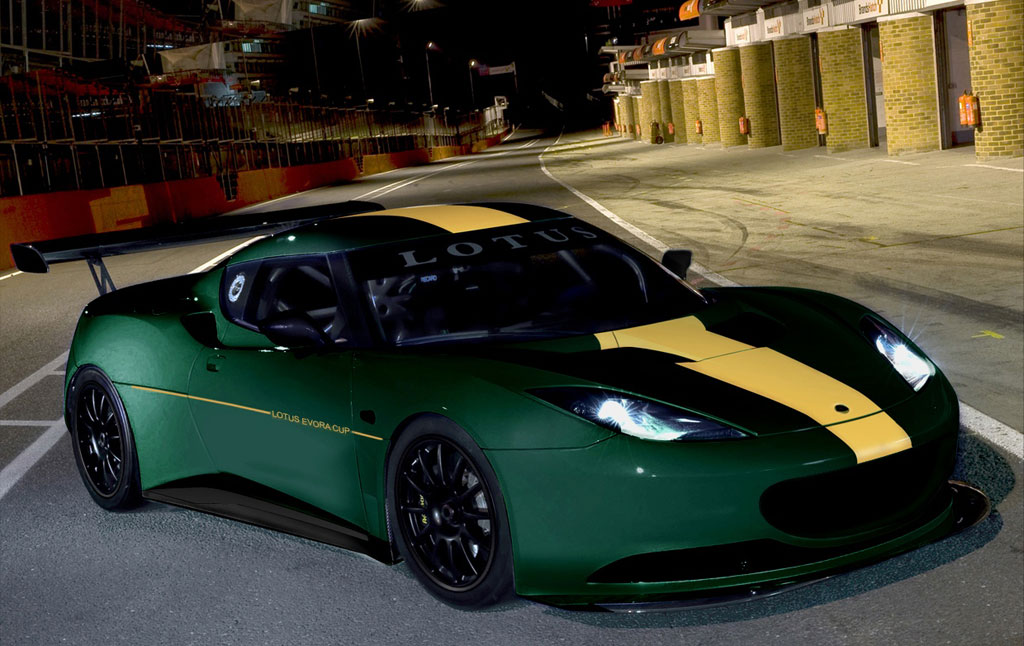
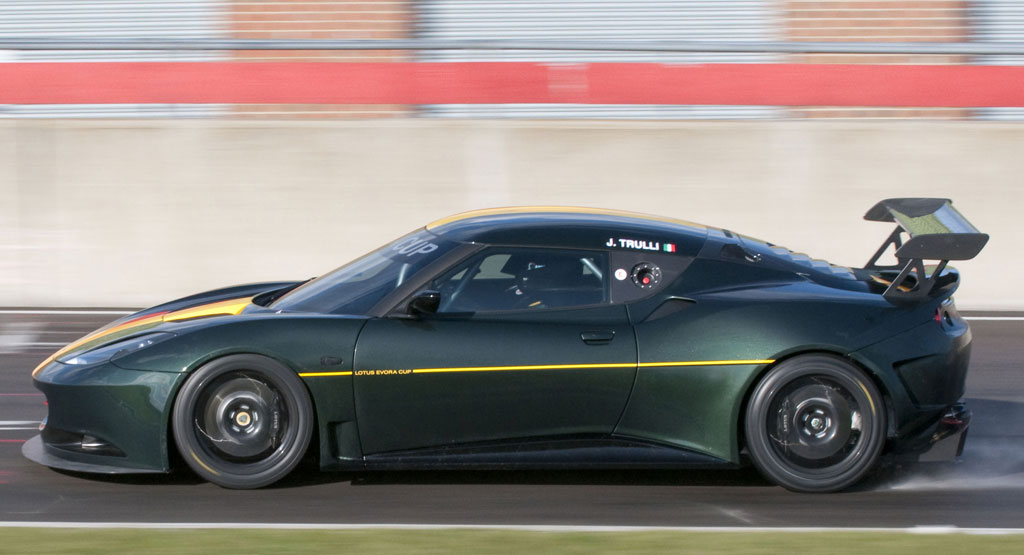
Lotus Evora Cup.


F1 Racing driver Jarno Trulli assists in the development of the Lotus Evora Cup race car during its first test session at Snetterton.

The Lotus Evora Cup race car is the latest addition to the Lotus Motorsport racing stable. Fresh from its debut at the Autosport International racing car show in Birmingham the Evora Cup race car was given its first shake-down test at a wintery Snetterton circuit in Norfolk, UK on the 10th and 11th of February 2010.

Lotus Motorsport is conducting an extensive development program for the Evora Cup race car, with Jarno Trulli and his Race Engineer, Gianluca Pisanello bringing their vast racing, development and engineering experience to fine tune the latest Lotus mid-engined race car.

Jarno Trulli and Gianluca Pisanello provided specific input into the aerodynamic balance for slow, medium and fast corners, guidance on the racing setup of the suspension geometry and direction on the engine's calibration.

After driving the Lotus Evora Cup for the first time, Jarno Trulli said, "I have enjoyed driving the road going Lotus Evora very much and I believe that the Evora Cup will be a very competitive race car package. It was very rewarding to be the first to drive the Evora Cup race car even though the snowy conditions at Snetterton were fairly challenging at times!"

Lotus Evora Cup

Jarno continued, "The car will continue to be developed with new updates coming soon, but even after the initial drive it is obvious that the car has huge potential. I look forward to working with Lotus Motorsport in developing the car further and I know that my years of motorsport experience will help make the Evora Cup race car even better."

Claudio Berro, Director of Motorsport at Group Lotus plc stated, "It is a privilege to work on the development of the Evora Cup race car with such an experienced driver and engineering team as Jarno Trulli and Gianluca Pisanello and I believe that this collaboration will produce a great race car for a range of motorsport applications. It is a very exciting time for Lotus and I am honoured to be leading the motorsport programmes at Lotus, starting with the Lotus Evora Cup racing car and race series.

Gianluca Pisanello, Race Engineer for Jarno Trulli said, "I am impressed with the whole Evora Cup race car package, which demonstrates that the road going Lotus Evora is such a competent sports car in the first place and an excellent basis to develop a competitive race car."

In the past a number of Lotus F1 drivers have successfully raced or assisted in the development of Lotus Cars including F1 World Champions Jim Clark and Nigel Mansell. Jim Clark was a great exponent of the three wheel drift in his Lotus Cortina, campaigning the Lotus to win the British Touring Car Championship in 1964. Whilst Nigel Mansell raced for Lotus he was involved in the development of the prototype Active Suspension Lotus Esprit.

The Evora Cup race car is an evocative sports car that will offer a great platform to race in high level motor sport. The GT4 race car will go on sale starting at £120,000 excluding taxes for the sprint racing version, with the endurance specification race car £150,000 excluding taxes.

The final design, aero' package and techincal specifications will be presented at the Geneva Motorshow in March 2010.
Photos:zercustoms

Lotus T127 - Lotus Cosworth Racing Launch, 12.02.2010, London, England


Coloured deep green with yellow trim in recollection of the famous British name's evocative history, the Malaysian-owned team launched the car in London on Friday evening.
With USF1 and Campos yet to unveil their cars, the mere presentation of the T127, shakedown debuted at Silverstone earlier this week, is a feat in itself, given that Lotus was the last outfit to be granted an entry for 2010.


Lotus T127 - Lotus Cosworth Racing Launch, 12.02.2010, London, England

"I'd just love to finish every race," the Malaysian-owned team's boss Tony Fernandes said.
The car's technical chief, Mike Gascoyne, admitted the T127 was designed very quickly starting in September and has therefore been born slightly overweight.
"We know it is not going to be easy. We are running out of time before Bahrain," said Jarno Trulli, whose teammate this year is another established F1 driver, Heikki Kovalainen.

Lotus T127 - Lotus Cosworth Racing Launch, 12.02.2010, London, England

"What they have achieved so far is great but for this year we have to be realistic. We know we will have troubles, but we have to be reliable, decent and show great promise," he told the BBC.

Lotus T127, Lotus Cosworth Racing Launch, 12.02.2010, London, England

Gascoyne said he felt "shell-shocked" that a car has been produced in merely five months, describing the T127 as a "good, solid, current car".
It will make its proper test debut at Jerez mid next week.

Tony Fernandes (MAL), Malaysia Racing Team Principal, Jarno Trulli (ITA), Fairuz Fauzy (MAL) and Heikki Kovalainen (FIN) - Lotus Cosworth Racing Launch - Formula 1 launch, 12.02.2010, London, England

Also at the launch was Lotus team founder Colin Chapman's widow Hazel and son Clive, and several historic Lotus F1 cars.
More Photos

Mark Webber (AUS) Sebastian Vettel (GER) unveil RB6 during winter testing at Circuito De Jerez, 10.02.2010, Jerez de la Frontera, Spain

The new car to be unveiled and debuted at Jerez on Wednesday morning is an "evolution" of its successful 2009 predecessor, Red Bull driver Sebastian Vettel has revealed.

Mark Webber (AUS) Sebastian Vettel (GER) unveil RB6 during winter testing at Circuito De Jerez, 10.02.2010, Jerez de la Frontera, Spain

The launch of the RB6, because it is the last of the main contenders to be revealed in 2010, and also because the team finished the 2009 season as the pacesetter, is highly anticipated.

Red Bull RB6 launch photo - 10.02.2010

"The RB6 will be more of an evolution," Vettel said. "Therefore, we decided to not be there at the first (Valencia) test."

Red Bull RB6 launch photo - 10.02.2010

Vettel, still just 22 but tipped by Bernie Ecclestone and others as the 2010 championship favourite, will take over the car from his Australian teammate Mark Webber on Friday.

Red Bull RB6 launch photo - 10.02.2010

A day later, he will be in action as the test concludes, when his countryman, friend and Race of Champions teammate Michael Schumacher is running for Mercedes GP.

Mark Webber (AUS) Sebastian Vettel (GER) unveil RB6 during winter testing at Circuito De Jerez, 10.02.2010, Jerez de la Frontera, Spain

Asked about competing with the 41-year-old this year, the German told Motorsport Aktuell: "If he has most of the (media) reports, but I have most of the trophies, that will be alright with me."
More Photos

Force India reveals 2010 car VJM03

发表者 ddgg 2/9/10

Adrian Sutil (GER), Vitantonio Liuzzi (ITA), Paul Di Resta (GBR), Force India VJM03, Silverstone, England, 08.02.2010

The Force India Formula One Team finished the 2009 season as a genuine regular contender for points and the new 2010 challenger, the VJM03, builds on the solid foundations established by its predecessor, which took pole for the Belgian GP. With driver consistency in Adrian Sutil and Tonio Liuzzi and the able support of Paul di Resta in the test and reserve driver role, this year the team is looking forward to a strong performance right from the start of the year.

'Our goal is to continue on the same path of performance improvement that we had at the end of 2009,' says chairman and team principal Dr Vijay Mallya. 'I don't think I am being over-proud when I say 2009 was an exceptional year for us. The bare statistics say it all: one podium, one pole position, one fastest lap, a further five top 10 starts and 13 points. We've learnt from our experiences and we've come out a better team: resilient, resourceful and now resurgent. I hope 2010 will see this great progress carrying forward. We've got one podium so far but I would hope that, this time next year, I'm talking about more points and more podiums. I'm confident we can get this, why not aim high?'

Force India 2010 VJM03 car - 09.02.2010

While the VJM03 is an evolution of last year's strong car, it incorporates the package of rules changes introduced for this year, including the requirement for a larger fuel tank as a result of the refuelling ban and a switch to narrower front tyres.

Design director Mark Smith explains, 'The VJM03 is definitely an evolution of the VJM02 in terms of the design philosophies we have developed at Force India over the last year. We are very happy with the direction, therefore we have opted to evolve the car rather than significantly revise.

'Obviously one of the major aspects we have had to contend with are regulation changes which have had a considerable impact on some aspects of the design of the car. The removal of refuelling from races increases the amount of fuel needed to be stored in the cars - almost twice the amount we ran in 2009. There is a compromise now: either make the car much longer or wider, or, as we have done, a combination of both. This of course has influenced the mechanical design solutions and also the aerodynamics, specifically with respects to the diffuser and bodywork.

Force India 2010 VJM03 car - 09.02.2010

'Even with the ban of double diffusers for 2011, we recognise that we still have to push as much as we possibly can in this area in 2010 as we have targets to meet and the double diffuser is a key development aspect of the car.' Last year's VJM02 was noticeably quicker on the low downforce circuits, however Mark is confident that this year the VJM03 will be strong across the board: 'The VJM02 was a relatively low drag car that showed well on the low downforce tracks. As was demonstrated
throughout 2009, that was a useful attribute but as we go into 2010 we have tried to maintain a high level of aerodynamic efficiency, but we recognise that our championship position will be enhanced by a general level of performance that is suited to all types of circuits. We have, we believe, quite an efficient car overall.'

Force India 2010 VJM03 car - 09.02.2010

Adrian Sutil is eagerly anticipating the start of the season, '2010 is a really important season and we are very optimistic about going well. I think this year it's important to be consistent from the first race. I'd like to be in the midfield and be competitive from Bahrain. It's the first time we have been completely on schedule so I feel this will be the first season when I can show from the beginning to the end what is possible with the car and what I can do. Of course we will have updates and performance packages from this point on but I hope we will be strong from the first practice session rather than compromising at the start.'

Force India 2010 VJM03 car - 09.02.2010

Meanwhile Tonio Liuzzi is also going to the season with a strong goal, 'After one and a half years in a test role, I feel really prepared, both physically and mentally for a full race season. My objective is to be as strong and consistent as possible and give good feedback to the team to help them improve. For sure scoring points as many times as I can is going to be the
key and you never know, perhaps we can get something more as well if everything comes together.'

The VJM03 will make its official testing debut on 10 February at the Jerez circuit in Spain. Tonio Liuzzi will be on driving duties for the first two days before Adrian Sutil takes over on 12 February for a further two days. Paul di Resta will step into the car on 17 February in Jerez.
More Photos


The launch of Virgin's 2010 car ended in disappointment on Wednesday, when the live online video stream failed to materialise.
Technical problems meant the online event was watched by a global audience of zero, with the first photos of the striking red and black car appearing only hours later.
"Calm down people. I'll ask if I can put a picture on Twitter," said Brazilian driver Lucas di Grassi.
The VR-01 has now been taken to Silverstone for a two-day shakedown beginning on Thursday.
It will then join the official group test action at Jerez next week.
Source: GMM More Photos


Contary to reports, Sebastien Buemi drove in icy conditions in Canada last weekend.
The Swiss driver's demonstration run in a Red Bull car on the frozen waters of the Olympic Basin, located behind the Circuit Gilles Villeneuve, was called off due to "unstable ice conditions".

Sebastien Buemi, Red Bull RB5, Lac-a-l'Eau-Claire, Quebec, Canada

But around the snow-lined Canadian GP circuit itself, and at the Lac-a-l'Eau-Claire in Quebec, Toro Rosso's Buemi got up to speed with his set of special tungsten-studded Bridgestone tyres.

Sebastien Buemi, Red Bull RB5, Lac-a-l'Eau-Claire, Quebec, Canada

"(It was) a bit cold but in the end, it is good to be back!" said the 21-year-old.

Sebastien Buemi, Red Bull RB5, Circuit Gilles Villeneuve

More Photos

/