Content feed Comments Feed
https://blogger.googleusercontent.com/img/b/R29vZ2xl/AVvXsEjwyMFzFySiQpaUXy-bPhyphenhyphenpyvAkgRSAKv-_DYmCic9xNUi_Z4KXJlXdnTWuyJqq577-gjGTpHaBy2NBDuAj0mC6dzJM9ljdaML0DKnX-abhRdAX4gi76v6nMOj5XgKZeLces-xK_vKfrsPG/s1600/2013-Renault-Clio-Cup-0.jpg
2014 Renault Clio Cup【Video】Renault has released the first details for the 2014 Clio Cup. The 2014 Renault Clio Cup will be exclusively offered will go on sale in September of 2013 with pricing starts at €37,800.
Showing posts with label Green Car. Show all posts

LA 2010: Toyota RAV4 EV

发表者 ddgg 11/20/10


Toyota has releases the new Toyota RAV4 EV at the Los Angeles auto show. the Toyota RAV4 has the body of the RAV4 SUV with the powertrain supplied by Tesla. The exact specs of the Toyota RAV4 have not been revealed yet, but the manufacturer says it's currently testing it with a lithium metal oxide battery with an output rated in the mid-30kwh range. The company says about the Toyota RAV4 that its battery size, final output and price list haven not been decided yet. However, they do mention that the electric Toyota RAV4 will come on the market in 2012.

Exact shipping estimates and such haven’t been announced, but there’s clearly a bigger market for the EV this time than when the first generation hit the streets in 1997. Consumers are aware of the technology, gas is dramatically more expensive, and the nerd stigma was replaced by an eco-hip look. The infrastructure still isn’t where it needs to be for mass adaption but Toyota should have no problem moving more than the 1,484 that it did back in the ’90s.

The RAV4 EV features several distinct exterior styling changes, and aside from new EV badging and a custom “mutually exclusive” exterior paint shade, distinct items include a new front bumper, grille, fog lamps and head lamps. Inside, there’s custom seat trim, multimedia dash displays, push-button shifter and dashboard meters in terms of new items.

Toyota and Tesla are keeping extremely quiet on the exact specs of the car, but it's reasonable to expect the RAV4 EV will feature a version of the motor found in the Tesla Model S electric saloon. It should also feature one, or a choice of, the Model S' batteries, which provide either 160, 230 or 300 miles of driving range.


Toyota RAV4 EV Toyota RAV4 EV Toyota RAV4 EV Toyota RAV4 EV Toyota RAV4 EV Toyota RAV4 EV Toyota RAV4 EV Toyota RAV4 EV Toyota RAV4 EV Toyota RAV4 EV Toyota RAV4 EV Toyota RAV4 EV Toyota RAV4 EV Toyota RAV4 EV Toyota RAV4 EV Toyota RAV4 EV Toyota RAV4 EV Toyota RAV4 EV Toyota RAV4 EV Toyota RAV4 EV Toyota RAV4 EV Toyota RAV4 EV Toyota RAV4 EV Toyota RAV4 EV Toyota RAV4 EV Toyota RAV4 EV Toyota RAV4 EV Toyota RAV4 EV Toyota RAV4 EV Toyota RAV4 EV


Press Release

TOYOTA DEBUTS 100-MILE RANGE, RAV4 EV DEMONSTRATION VEHICLE AT LOS ANGELES AUTO SHOW

Toyota/Tesla Collaboration To Build, Demonstrate And Evaluate 35 Vehicles: Fully Engineered Second-Generation RAV4 EV Slated For 2012 On-Sale Date

LOS ANGELES, November 17, 2010 -- Toyota Motor Sales (TMS), U.S.A., Inc. (TMS) debuted today the second-generation Toyota RAV4 EV at a news conference at the Los Angeles Auto Show. A total of 35 vehicles will be built for a demonstration and evaluation program through 2011, aiming at market arrival of a fully-engineered vehicle in 2012. The fully-engineered vehicle will have a target range of 100 miles in actual road driving patterns, in a wide range of climates and conditions.

"When we decided to work together on the RAV4 EV, President Akio Toyoda wanted to adopt a new development model that incorporated Tesla's streamlined, quick-action approach," said Jim Lentz, president and chief operating officer, TMS. "The result was a hybrid – a new decision and approval process and a development style that our engineers refer to as "fast and flexible."

Led by the Toyota Motor Engineering and Manufacturing North America (TEMA) Technical Center in Michigan, the new development model helped reduce development time without compromising product quality. The team has accomplished this by approaching the project as they would a typical mid-cycle "major-minor" product change. Specifically, midway through a generation, the team began with a fully engineered current-generation RAV4, to which was added a major powertrain option, along with minor feature and cosmetic changes.

Tesla was responsible for building and supplying the battery, as well as other related parts, that met specific Toyota engineering specifications in performance, quality and durability. Toyota was responsible for development and manufacturing leadership and the seamless integration of the powertrain.

"From the beginning, the customer experience has been the focus," said Lentz. "In other words, how do we deliver an unconventional product to mainstream customers that is compelling and affordable and that offers an acceptable level of daily convenience."

A large part of the team's focus on the customer experience targeted driveability. In this case, the end goal is a vehicle with driveability characteristics as close to the conventional RAV4 as possible.

For example, the demonstration vehicle weighs approximately 220 pounds more than the current RAV4 V6 yet it will accelerate from zero to sixty nearly as quickly.

This added weight factor required significant retuning of major components and a prioritized focus on weight distribution. Not only were suspension and steering modified significantly, major components needed to be relocated to better balance the increased mass of the battery pack.

The demonstration vehicle Toyota is currently testing is powered by a lithium metal oxide battery with useable output rated in the mid-30 kwh range. However, many decisions regarding both the product, as well as the business model, have not been finalized. Battery size and final output ratings, as well as pricing and volume projections of the vehicle Toyota plans to bring to market in 2012, have not been decided.

As for a final assembly location, Toyota is considering many options and combinations. The basic vehicle will continue to be built at its Canadian production facility in Woodstock, Ontario. Tesla will build the battery and related parts and components at its new facility in Palo Alto, Calif. The method and installation location of the Tesla components into the vehicle is being discussed.

The RAV4 EV received several distinct exterior styling changes including a new front bumper, grille, fog lamps and head lamps. New EV badging and the custom "mutually exclusive" paint color, completed the transformation. The interior received custom seat trim, multimedia dash displays, push-button shifter and dashboard meters. The RAV4 platform brings a 73-cubic-foot cargo area with rear seats folded down – no cargo space was lost in the conversion to an electric powertrain.

In 1997, Toyota brought to market the first-generation RAV4 EV in response to the California zero emission vehicle (ZEV) mandate and was the first manufacturer to meet the mandate's Memo of Agreement on volume sales. Powered by a nickel-metal hydride battery pack, the vehicle had a range of between 80-110 miles on a single charge. From model year 1998 to model year 2003, only 1,484 vehicles were sold or leased in the U.S. 746 first-generation RAV4 EVs are still on the road (www.toyotarav4ev.com).

"Price and convenience proved to be critical success factors and they remain so today," said Lentz. "But much has changed in the last few years. Most importantly, the growing level of awareness that sustainable mobility will come at a cost that must be shared by the automakers, government and the consumer."

Toyota's approach to sustainable mobility focuses on the world's future reliance on mobility systems tailored to specific regions or markets, rather than individual models or technologies. It acknowledges that no one technology will be the "winner" and that a mobility system in Los Angeles will probably look very different from one in Dallas or New York or London or Shanghai.
Toyota's comprehensive technology strategy is a portfolio approach that includes a long-term commitment to hydrogen fuel cells, plug-in hybrids and battery electrics all driven by the further proliferation of conventional gas-electric hybrids, like Prius as its core technology.

Toyota has announced that coinciding with the arrival of the RAV4 EV in 2012 it will launch, in key global markets, the Prius PHV (plug-in hybrid) and a small EV commuter vehicle. It will also launch, in key global markets, its first commercialized hydrogen fuel cell vehicle in calendar year 2015, or sooner. Finally, by the end of 2012, Toyota will add seven all new (not next-generation) hybrid models to its portfolio.

TOYOTA RAV4 EV PERFORMANCE/SPECS

Exterior:

  • Unique front and rear styling
  • LED Foglamps
  • 18" Alloy wheels
  • Special pearl white paint with aqua base – "mutually exclusive"

Interior:

  • Smart key system with push button start
  • Combination synthetic leather and fabric seating surfaces
  • Touch screen DVD Navigation system
  • Cargo volume equal to 2010 RAV4

Mechanical:

  • Powerful electric motor with Lithium-ion (Li-ion) battery pack
  • Zero emission vehicle (ZEV)
  • Class-leading driving range, acceleration, and top speed
  • Real world driving range of approximately 100 miles

Mercedes-Benz ESF Safety Car

发表者 ddgg 3/7/10

mercedes benz esf 2009 experimental safety vehicle

The Mercedes-Benz S400 Hybrid ESF Safety Prototype made its debut last fall, and we brought you the official details on the car then, but this week TheCarConnection's John Voelcker got to spend some time with the car in the high-tech safety-featured flesh.

Mercedes_Benz_ESF_2009_Prototype

One of the most unique aspects of the latest ESF Safety prototype is its heavy use of inflatables--from inflatable door bars, to size-adaptive air bags to our favorite, though it's still years away from production, the "braking bag."

mercedes benz esf 2009 experimental safety vehicle

Functioning much like a typical in-cabin airbag, but wrapped in steel and rubber, the braking bag senses an emergency-stop situation and deploys to increase the amount of friction the car applies to the road, and also lifts the front of the car to reduce dive and improve the angle of impact with another car.

mercedes benz esf 2009 experimental safety vehicle

Catch the full roundup of the car's safety features over at TheCarConnection.

Mercedes-Benz ESF 2009 safety concept car, driver seat vertical central head curtain

More Photos

Geneva Motor Show: Rinspeed UC

发表者 ddgg 12/17/09

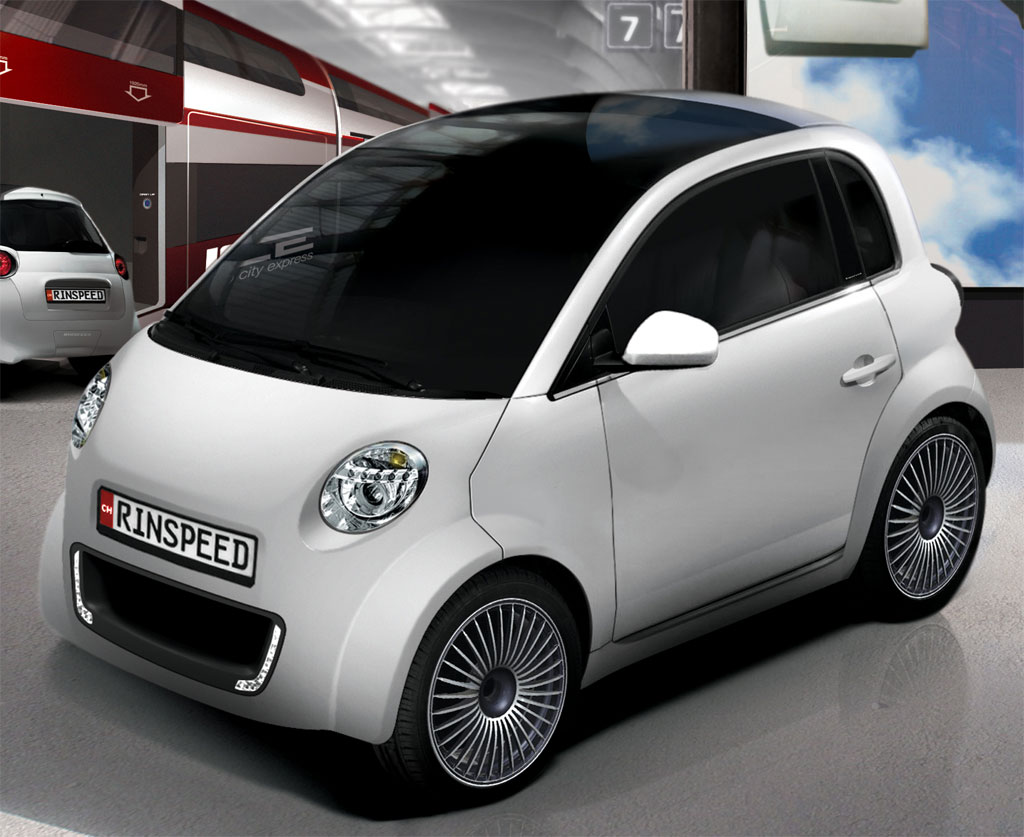
Rinspeed UC 2.jpg

World Debut at the 80th Geneva Motor Show, March 4th through 14th, 2010
Rinspeed Presents an Intelligent Mobility Concept Centered on the “UC?” Electric Car - an Innovative Commuter Vehicle

A Clever E-Speedster to Fight Gridlock

Automobile, Train and the Web Form a New Kind of Symbiosis at the Geneva Motor Show 2010

Automobile, Train and the Web Form a New Kind of Symbiosis at the Geneva Motor Show 2010 (March 4th - 14th, 2010)

For the first time in its long history of developing groundbreaking concept cars the Swiss automobile and concept powerhouse Rinspeed is creating not just a car but a entire mobility concept. The highly likeable two-seater is powered by an electric motor and is aptly named “UC?”, which stands for “Urban Commuter” or “You see?”. It was designed for possible future series production.

Rinspeed UC 3.jpg

Nomen est omen: The little speedster measures just 2.50 meters in length and is intended to help avoid gridlock in the inner cities. At the same time an advanced railcar loading system will add the option to cover long distances by train, comfortable, without traffic jams and stress-free. The desired mobile carport with integrated battery charging station is conveniently booked via the internet.

Rinspeed boss Frank M. Rinderknecht: “UC? - it’s a new and highly emotional web-based car world that interweaves individual and public transport in an intelligent way. We want to create a community of people who are open for a new definition of mobility.”

The lightweight "lovebug" is operated with a central joystick and delivers 124 Newton meters of torque. It reaches a top speed of 110 km/h and has an operating range of 120 kilometers.
But the most important aspect of the vehicle is that there is a good chance that it will be built in series production. The concept is designed be easily adapted and integrated by volume manufacturers. Intensive dialogues at the highest levels are already well underway.
More Photos

Audi A3 TDI is Green Car of the Year 2010


Green Car Journal Announces Clean Diesel Winner at the Los Angeles Auto Show

LOS ANGELES, Dec. 3 -- The 2010 Audi A3 TDI has been named Green Car Journal's 2010 Green Car of the Year®. The clean diesel from Audi rose to the top in a stellar field of hybrids and advanced diesel models that all offer exceptional fuel economy and low emissions. This marks the second year in a row that a clean diesel vehicle has taken the top prize.

"The Audi A3 TDI offers it all," says Ron Cogan, editor and publisher of Green Car Journal and editor of GreenCar.com. "This compact luxury car features an impressive EPA estimated 42 mpg on the highway - a 50 percent highway fuel efficiency improvement over the standard gasoline engine A3. Plus, this Audi's quiet, clean diesel engine delivers loads of low-end torque and a fun-to-drive experience, all with the functionality of a 5-passenger hatchback."

Along with setting the bar for highway fuel economy in the compact luxury car segment, Audi's 50-state certified A3 TDI is powered by a 2.0-liter turbo direct injection (TDI) engine with a standard S tronic dual-clutch automatic transmission and comes at an MSRP of $29,950.

"In winning the 2010 Green Car of the Year Award, the Audi A3 TDI demonstrates the bright future that clean diesel technology provides through reduced fuel consumption and greenhouse gas emissions," said Johan de Nysschen, President, Audi of America. "This honor demonstrates that the A3 TDI is a ready-now solution to our society's toughest transportation issues."

Audi A3 TDI is Green Car of the Year 2010

The Green Car of the Year® jury, comprised of six environmental and automotive experts along with Green Car Journal editors, selected the 2010 Audi A3 TDI from a field of five finalists that also included the Honda Insight, Mercury Milan Hybrid, Toyota Prius and VW Golf TDI.

This year's invited jurors included Dr. Alan Lloyd, president of the International Council on Clean Transportation; Carl Pope, executive director of the Sierra Club; Jean-Michel Cousteau, president of Ocean Futures Society; Matt Petersen, president of Global Green USA; automotive expert and television host Jay Leno; and automotive icon Carroll Shelby. The Green Car Journal has been unveiling the Green Car of the Year® winner at the LA Auto Show every year since it initiated the annual award in 2005.

"This was the strongest field of nominees ever for our Green Car of the Year® program," said Cogan. "It's a clear indication that the auto industry is on track to deliver an expanding number of 'green' car choices at the showroom in coming years. It's also an affirmation that fuel-efficient clean diesel models are becoming a serious competitor in the American market."

Audi A3 TDI is Green Car of the Year 2010

About Green Car of the Year®

The Green Car of the Year® program focuses on environmental achievement without regard to a particular technology or fuel. All production models on sale by January 1 of the award year and widely available to consumers are considered as nominees. Fuel efficiency, exhaust emissions, and CO2 reduction achievements are among many primary considerations. Market significance is important, as is a model's potential for influencing the expansion of environmentally positive fuels or technologies throughout an automaker's product line. Green Car of the Year® is a registered trademark of Green Car Journal and RJ Cogan Specialty Publications Group, Inc. Additional information about Green Car Journal and a sample downloadable issue of the print magazine can be found at GCJUSA.com.

Audi A3 TDI is Green Car of the Year 2010

About the Los Angeles Auto Show

The show opened for media only Dec. 2 and 3 with public days running from Dec. 4-13. The Organisation Internationale des Constructeurs d'Automobiles (OICA), the world automobile trade association, has officially named the Los Angeles Auto Show as one of its sanctioned international exhibits for the 2009 auto show season. For additional information about the Los Angeles Auto Show visit www.LAautoshow.com.
More Photos

Caterham pursuing electric sports cars

发表者 ddgg 10/21/09


Further, Caterham is planning a one-make race series in 2011 to show off its new green sportscar, which may well be followed up in 2012 with a production model if sufficient demand is found. Performance will reportedly to be just as sprightly in EV form as it is with the firm's normal gasoline-fed engines.


The same things that makes the cars from British boutique automaker Caterham sporty and fun to drive could also potentially make them excellent choices for alternative powertrains. There's plenty of available real estate under the hood, a simple rear-wheel drive chassis and, above all else, a distinct absence of weight.


As such, it's not surprising to hear that Caterham is looking into both hybrid and fully electric drivetrains. According to Autocar, Caterham chief Ansar Ali said at the Tokyo Motor Show that his company would unveil an eco-friendly prototype before the end of the year. Both the hybrid and electric powertrains will be sourced from unnamed manufacturers.
More Photos


Moller International, Inc. Skycar Could Allow Military to Do More in Afghanistan With Fewer Soldiers

August 27, 2009 /EIN News/ -- Moller International (the "Company" -- OTC-BB: MLER) is pleased to announce today that its Skycar technology has gained ground within the military for its use in high-tech, demanding battlefield applications like those in Afghanistan. "Afghanistan is not Iraq" stated Lieutenant Colonel James Thomas, 304th SB, 3rd Expeditionary Sustainment Command. "The MRAP (Mine Resistant Ambush Protected) vehicle that turned the tide of battle in Iraq will have much less impact in Afghanistan," he continued in a recently issued white paper entitled Winning an Asymmetric War with Skycars. This report, directed to the Defense Advanced Research Projects Agency (DARPA), spelled out the numerous advantages the Skycar(R) aircraft could offer the military in its effort to win the war in Afghanistan."Poor and unimproved roads and rugged terrain severely limit the use of the MRAP. The Moller Skycar(R) provides a more cost effective, highly maneuverable, lethal and safe platform for the 21st century soldier to dominate and win in an Asymmetric Warfare Environment. The Skycar(R) will become the MRAP vehicle of Afghanistan. The ability to safely and rapidly employ soldiers on the battlefield enables us to exercise economy of force on the battlefield, doing more with fewer soldiers."

Lieutenant Colonel Thomas is not the first voice within the military to suggest the use of the Skycar in improving maneuverability on the battlefield. In an article titled A Revolutionary Vehicle for the Future, Colonel Larry Harman, then Vice Director of the Combat Service Support Battle Laboratory at Fort Lee, Virginia discusses the Skycar's military version referred to as the LAMV (pronounced "lam-vee"), or light aerial multipurpose vehicle."(The) LAMV will benefit the Army's battlefield distribu­tion concept tremendously because it will be able to move commodities rapidly when and where they are needed across a widely dispersed battle space. Both air and ground main supply routes (MSR's) would exist throughout the battle space," he goes on to say."Without any doubt, this technological innovation will succeed internationally in the private, commercial, and mili­tary sectors. I hope that the U.S. Army will be the first army in the world to embrace and exploit this technology. But sooner rather than later, this aerial vehicle technology will affect all of our lives. It is just over the horizon."

About Moller International

Moller International is a fully reporting public company (OTC-BB: MLER) that developed and flight-tested a utility or recreational, two-passenger VTOL aircraft called the NeueraTM. This was followed by the development and initial flight-testing of a four-passenger VTOL aircraft called the Skycar(R). The Skycar(R) has the potential to provide an airborne alternative to a significant portion of the miles now traveled by automobile. Both aircraft use the Company's Rotapower(R) rotary engine, designed specifically for applications requiring high power along with low weight, volume, hazardous emissions, fuel consumption and cost per horsepower.

The Skycar(R) and NeueraTM have been featured on a number of TV programs including CBS 60 Minutes "Highway In The Sky", NBC's Today Show "Today's American Story", and History Channel's "Greatest Movie Gadgets: Then and Now."

Skycar(R), NeueraTM and Rotapower(R) are trademarks of Moller International in the USA and other countries.


Volkswagen has struck a deal worth "at least 10 million euros" with Wilhelm Karmann GmbH to keep the insolvent coachworks and specialty builder alive so it can reorganize a new company and "focus on building electric-powered cars." That's according to an unsourced report in the Neue Osnabruecker Zeitung that can be found on Bloomberg. A separate report on HLN.be says that the EV deal is worth 20 million euros, the fruits of which are expected to go on sale in 2011.


Earlier this year, Karmann showed off an EV concept called the E3 Limosine, co-developed with utility company Oldenburg Energy Group (EWE). Last October, Karmann said it would help build some of
DuraCar's Quicc! DiVas EVs.
More Photos


In a recent op-ed piece published in The Wall Street Journal, Alan Reynolds of the Cato Institute starts by making a few decent points about fuel taxation and fuel economy rules. Unfortunately, he undermines himself with some blatant errors and misinformation.


In discussing how Detroit automakers will deal with new fuel efficiency requirements, he makes the all-too-common mistake of referring to Ford's hybrid system as licensed from Toyota ("Similarly, Ford has the Toyota-licensed hybrid Fusion and will soon produce the European Ford Fiesta in Mexico").


The reality is that Ford independently developed its own hybrid system at the same time Toyota was masterminding its own. The basic architecture of both systems is the same and both are based on the concepts developed and patented by TRW engineers in the late 1960s. When Ford introduced the Escape Hybrid, Toyota went after the Blue Oval for infringing on its patents. Ford had patents of its own on the technology that Toyota was using.


Eventually, the two companies reached a cross-licensing agreement that gives both companies the right to build their own systems. Such cross-licensing agreements are common in these kinds of cases, but Ford did not use the Toyota hybrid system. The only other company that uses Toyota's system is Nissan for its Altima hybrid, and they actually buy hardware from Toyota.
More Photos

/